DNA, the latest tool for doing genealogy
Genetics only seems complicated because it is. In my opinion, we can not continue without giving honor on how the pioneers provided us with the tools we use to do “genetealogy” (a combination of genetics and genealogy). A little history on our subject is appropriate and maybe if you are interested, take a look at the Human Genome Project poster. After you take a look at the above links, you can see that we did not get to our modern day DNA testing without some very technical scientific work.
I actually have a goal that I would love to reach. The following is intended to combine what I know about genetics and perhaps pass on my knowledge in such a way that a person that is having a hard time grasping some of the concepts (like me), will be able to walk away with a better understanding. At the bottom of this page are references that I have used and feel they will build a foundation to this better understanding.
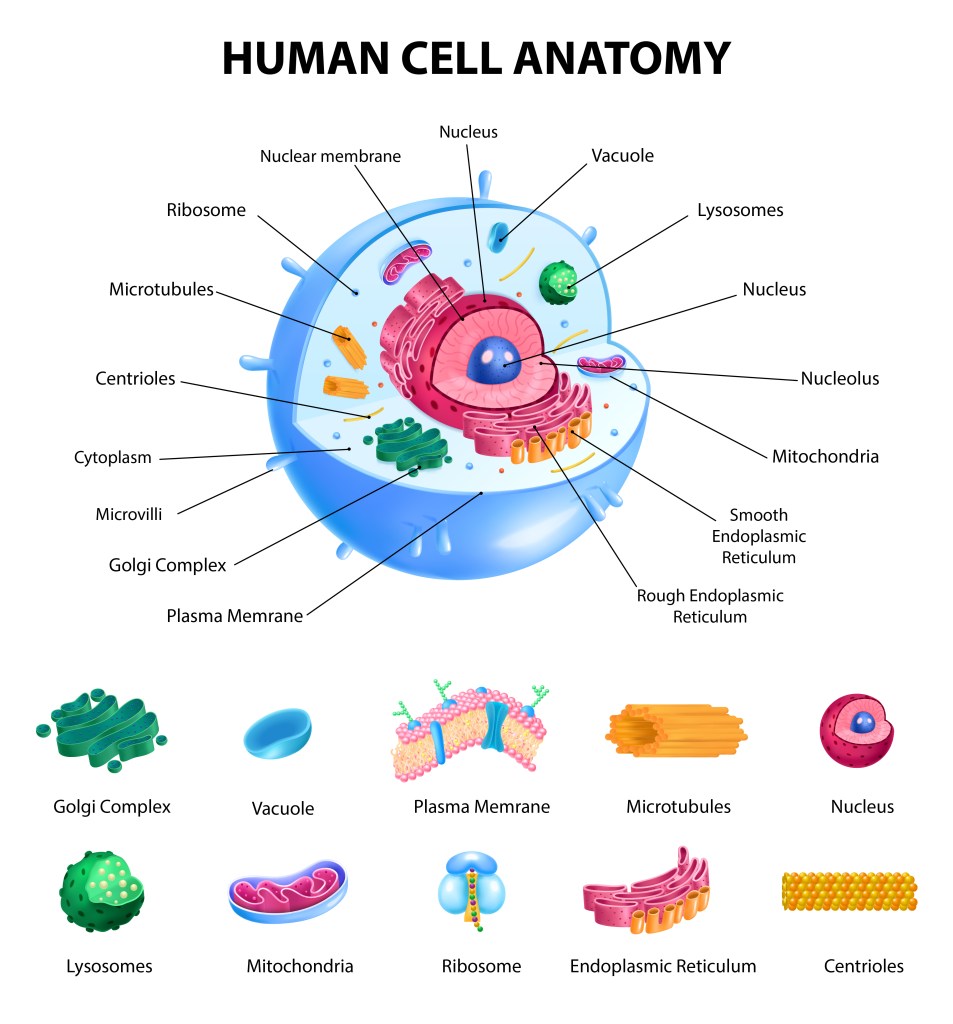
Here are some basic DNA concepts and definitions that I think may be helpful;
- The Cell – Your body has trillions of these hard-working units of life that are the building blocks of life. Your DNA is inside the nucleus of the cells. And also you find DNA in the mitochondria (which is a different kind of DNA). The DNA in the nucleus hands out operation instructions.
- Haplo- (Type -Group – Tree) – For simplicity at the moment, your Haplotype is derived from a grouping of Alleles (a pair of genes that occupy a location on the chromosome) in markers along in DNA. You will end up with a paternal Haplotype and a Maternal Haplotype. Haplogroup is your Haplotype that you share with other people. A Haplo-tree is sort of the evolution of your Haplotype as discoveries of mutations due to migrations. We will further talk about this a little later.
- Gene – As explained in the videos, the genes are sequences that give you certain traits and things like the color of your eyes. Also this an ongoing study that many of the companies are discovering things about your health.
- Chromosomes – Again, I really like the Stated Clearly explanation on YouTube explanation of what a chromosome is.
- DeoxyriboNucleic Acid – Just in case you wanted to know what DNA stood for.
- The DNA molecule – Is made of units called Nucleotides which has 3 components, Sugar, Phosphate, and the Base (Adamine, Guamine, Thymine, Cytosine). Don’t worry, kind of sounds technical, but, you really don’t need to fully understand it to work with your genetic family tree.
Before we go to far, it is very important to know that you have a Genealogical Family and you have Genetic Family. Your Genetic Family are the folks that you share DNA with and may not show up in your Genealogical family. That is because you may not have inherited all the genes that have been past down through the family generations.
DNA has come a long way since it’s early days. Thanks to companies like Ancestry.com, MyHeritage.com, 23 and Me and FamilyDNA, we can build genetic families and compare them to our genealogy and help us develop our tree.
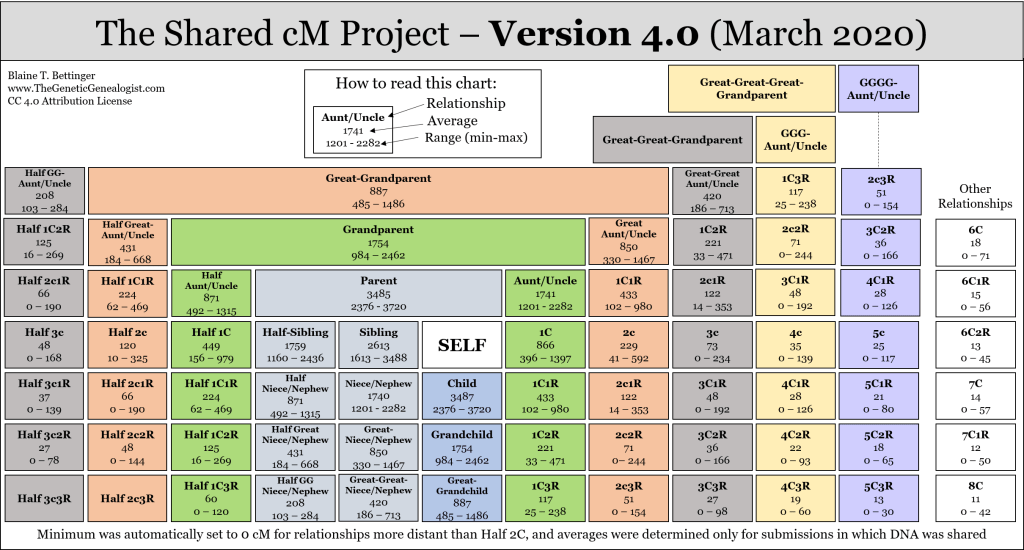
Perhaps you have tested your DNA at one of the companies above and your results have come back. Somewhere on the companies website, you will be able to see your DNA matches. The chart below will be helpful in determining how you connect with your match based on the amount of cM (centimorgans) you share.
Autosomal DNA (click for more)
This is probably the most popular test that people get. I am very happy that companies like Ancestry have spent tons of money in television advertising. The more people that test, the more people that go into the database.
There are five big companies that do testing, Ancestry, 23 and Me, MyHeritage, FamilytreeDNA and LivingDNA. There are a few others that I am not familiar with. GEDMATCH does not do testing, but, it allows your test results from the other companies to be uploaded into their database.
My DNA tests are in the databases of all the above companies.
This is a special test for men only. If you remember your biology class, you remember that your father only passes his Y chromosome to his son(s) and he also passes a X chromosome to his daughter(s). So if you are a male, you get a Y from your father and a X from your mother. Now if you are a female, you get a X from your father and a X from your mother. Confused yet? Don’t worry, it gets more confusing. You don’t have to know everything about the heart to know that it pumps blood. So you don’t have to know everything about chromosomes to know that you get the YDNA from your father and it is passed down from generation to generation for many generations and stays very stable for much longer that your autosomal DNA. So…with YDNA, you can use it to reliably trace your beginnings maybe a thousand years. Sounds pretty cool. It requires a little time and effort.
This is a special test that can be done with both male and female. This is very similar to the YDNA, only it is the DNA passed down from mother to daughter for many generations undisturbed because it is not recombined and is outside the nucleus. Your mother also passes her mitochondrial DNA to her sons, but it is only a one generation process and the sons do not pass it along. The cool thing about this, is your mother passed it down to her daughter(s) and son(s).
This test is a little different than the autosomal test, because it is testing the sex chromosome. You should not confuse this test with the mtDNA test . You get a Y chromosome from your father and a X chromosome from your mother, that makes you a male. You get a X chromosome from your father and a X chromosome from your mother and that makes you a female.
Some really good learning resources
Roberta Estes has a website that explains DNA in-depth https://dna-explained.com/
Diahan Southard is one of my favorite experts https://www.yourdnaguide.com/
Blaine Bettinger, it is hard to even mention DNA without bringing attention to his contribution to sharing genetics with genealogy. https://thegeneticgenealogist.com/
Blaine Wrote this paper in 2008 and is very informative
Sergio Pistoi, I read his book called DNA Nation and found his humor and style very enjoyable and informative. I have not read everything about him. https://www.greedybrain.com/
Home Page
This page is still a work in progress.
 Genealogy and More